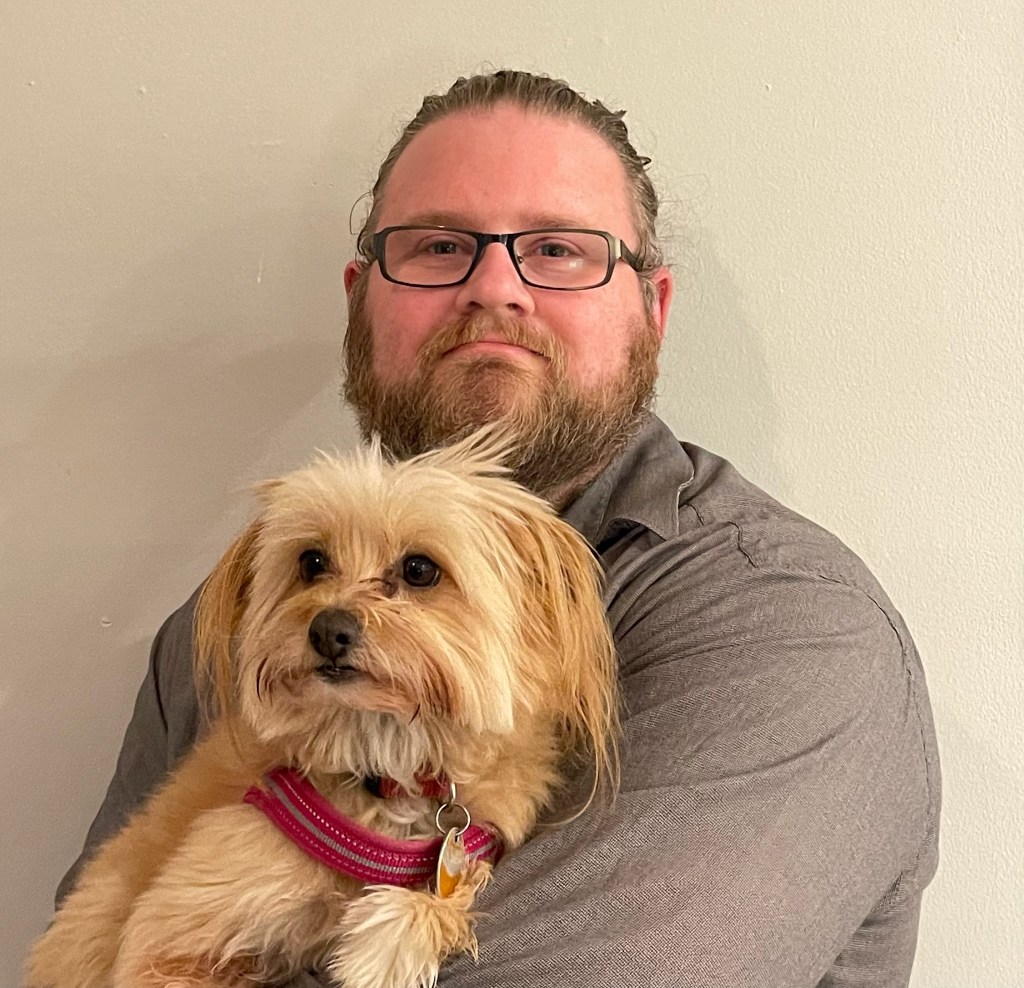
Dr. Christopher Douglas, an Assistant Professor of Eighteenth-Century British Literature, is from Aledo, IL. He earned his BA in English Secondary Education at Bradley University in 2005 before getting his MA and PhD in English Literature at Southern Illinois University, Carbondale.
Douglas is in his third year of teaching at JSU, all of which he says have been strange. “Most of my time here has been pandemic time, with the Fall 2019 semester being, in hindsight, a mostly noneventful semester of me learning the ropes at my new job, which transitioned very suddenly in Spring 2020 into pandemic teaching.” Douglas is teaching two in-person sections of English Composition II (EH102) this semester, as well as Survey of English Literature I (EH203) and Major Authors: The Gothic Novel (EH525), both of which are asynchronous online courses. He explained that the excessive nature of the novels in EH525 is what causes the class to be his favorite. “The Gothic novel from the 18th century and the early 19th is a genre of over-the-top emotions, dangers, and (real or imagined) supernatural threat.” Douglas provided an example of this with Matthew Lewis’ The Monk (1796), which contains French bandits, possessions, a surprise Satan appearance, and more.
Watching his students “get it” is Douglas’ favorite part of his job. Douglas enjoys watching his students not only gain new skills, like effective analysis and argumentation, but also something new about themselves. “If you can see something that people made for the joy of making it. . . and react to it, understand, and interrogate that reaction, and then share that experience with others, you’ve better understood yourself and the world around you, and you’re able to share that with others.” His favorite thing about the English Department itself is its ability to reach nearly every student on campus. English courses such as English Composition and Oral Communication are part of the core curriculum, so all students must take these courses before they graduate, which opens the door for students of different disciplines to meet each other and their teachers.
Last year, Douglas released two publications inspired by the ongoing COVID-19 pandemic. The first was “‘Bodies and Things, Both Putrid and Corrupt’: Miasma and Racial Anxiety in Hawthorne’s The Marble Faun,” which “looks at the ways in which miasmatic disease and atmosphere works in The Marble Faun (1860) as analogs for racial tension directly before the Civil War” and was featured in a special pandemic edition of the Nathaniel Hawthorne Review. The second was a brief piece where Douglas reflected on teaching Daniel Defoe’s A Journal of the Plague Year (1722) as COVID-19 first began to spread across America. Currently, Douglas is working on a chapter for an edited collection, Animal Satire, which is set to be published in the next year or so by Palgrave/Macmillian. He has already finished a chapter where he examines how Memoirs of Bob, the Spotted Terrier (1801) and Felissa; or The Life and Opinions of a Kitten of Sentiment (1811) “use satire to comment on slavery and religious hypocrisy from the vantage point of a small dog and cat, respectively.” Both stories are it-narratives (being told from the perspective of nonhuman characters) and fall under Douglas’ area of scholarly focus. Douglas is also working on a project where he emphasizes and explains the similarities between playing Animal Crossing: New Horizons (2020) and reading Robinson Crusoe (1719).
Douglas was awarded the Faculty Research Award at JSU last year, allowing him to present at three different online academic conferences on three different topics. He also recently performed Haydn’s Te Deum in C Major (1799)—which “is very baroque and demanding, but I think we did a lovely job of it”—as a member of the JSU Civic Chorale.
In his spare time, Douglas walks his dog Honey – a honey-colored shih-tzu/terrier mix – around town and campus and invites people to talk with him as he does so. And the dog is featured in daily “Honey-of-the-Day” social media posts. Douglas is also a member of the choir at St. Michael and All Angels in Anniston, in addition to the JSU Civic Chorale. Douglas bakes desserts and is a self-proclaimed amatuer powerlifter, as well. “I’m trying to work my way back up to deadlifting 500 lbs., but I have creaky old man knees.”
Douglas’ advice to his students is to be open. He feels that, living through a pandemic, he has learned that everyone is dealing with their own difficulties and struggles – even if it feels like we are the only person to do so. Douglas encourages students to ask questions and communicate with their teachers when they are having problems both inside and outside of the classroom. “I lost my grandfather to COVID-19 in November of 2020, and I made sure to be open about that with all of my own classes, so that they knew where I was at that moment. I wanted to give them exactly what I wanted from them – an open, honest discussion about my own struggles and asking for a little more time.”
 JSU Arts, Humanities & Sciences Blog
Leave a comment