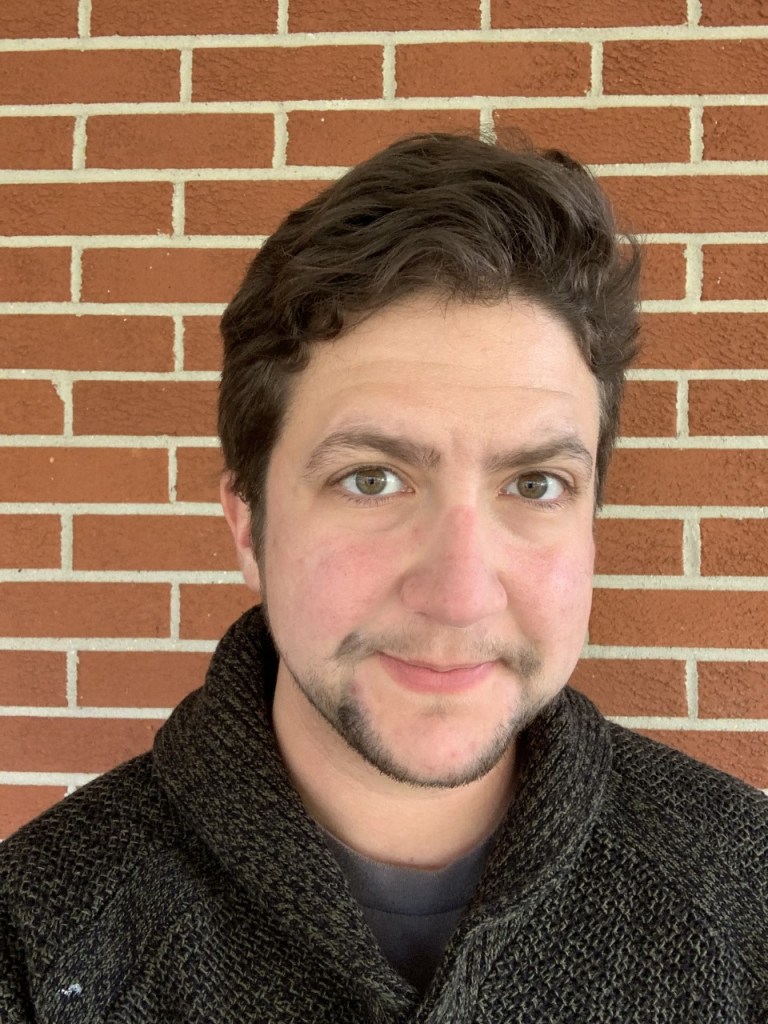
Professor Emrys Donaldson, Assistant Professor of English from Jericho, Vermont, currently lives in Anniston. They graduated summa cum laude from Cornell University in 2012 with their B.A. – having majored in English and minored in Cognitive Science – before earning their M.F.A in Prose from the University of Alabama in 2019.
Donaldson has been at JSU for three years; this semester, they are teaching Introduction to Creative Writing (EH251) and American Literature I (EH201). They are partial to teaching creative writing courses, as that is their academic focus, but still find plenty of joy and pleasure it working with students in any setting. About Introduction to Creative Writing, Donaldson shared, “I especially love [it] because, for many students, it’s the first time they get to write creatively and share their work in a classroom environment; seeing their excitement and exploration is wonderful.” Donaldson encourages all students to take advantage of the opportunity to take EH251 because it now has fewer pre-requisites and meets the Area II: Fine Arts distribution requirement.
Getting to know their students and “learning from them as [they] facilitate their learning journeys” is Donaldson’s favorite part about their job, as they are continuously impressed by students. Donaldson’s colleagues are their favorite thing about the English department itself, stating, “They’re a swell bunch!”
In addition to teaching, Donaldson has an active research agenda with several recent publications. They were a panelist for PEN America’s roundtable on Gender Identity, Sexuality, and Free Expression in Alabama as part of the national events occurring during Banned Books Week (September 2021).Donaldson also published “Tiny Haunted Empires: Domestic Fabulism in the Home in Sigizmund Krzhizhanovsky’s ‘Quadraturin’ and Kelly Link’s ‘Stone Animals’” in Connections and Influence in the Russian and American Short Story (Lexington Books, 2021).
Currently, Donaldson is working on The Queer Lives of Saints, which they explained is a collection of stories that “writes towards the caesuras in the historical record where trans lives existed and celebrates transitory space for resilience and fierce joy.” “The stories focus on religious, spiritual, and mystical experiences, communities, and struggles with C. Riley Snorton’s layers of attenuated meanings and what C. Libby terms the ‘apophasis of transgender,’” Donaldson said. After The Queer Lives of Saints, Donaldson plans to write a “collection of autotheoretical nonfiction essays focused on haptic ontologies in queer and trans studies.”
Donaldson has two completed books out on submission with agents and presses at this time. The first is The Festival, which they call an experimental novel, where “six queer friends in their thirties stumble through a climate-changed landscape to a music festival, which they hope will help them reclaim their youth and each other.” Along the way to the festival, the friends share stories: “a collector of feral kittens waxes poetic about his mother; a sapphic hydrologist incants strong women; a Milton fanboy hybridizes Middle English with modern text-speak in tales of rebel angels.” The other book is The Iridescents, a collection in which “relationship stories refract queer and trans narratives through lineal and forgotten spaces: community gardens in the shells of former malls and haunted virtual worlds; DIY ditch-dog rescues and backroom bodyhacking.” Publications such as Electric Literature, DIAGRAM, Gigantic Sequins, and The Rupture have previously featured select stories.
In their downtime, Donaldson enjoys spending time with their close friends, their three chickens, and Poutine and Kali, their pet dog and cat. Donaldson also likes to “write terrible puns (A fog you aren’t sure about? That’s a mistery.) and go hiking in the world-class outdoor recreation areas we are lucky to have here.”
Donaldson’s advice to their students is very honest and encouraging: “Life is long, much longer than the four years you’re in school (and yet too short to do something that bores you or makes you unhappy). It’s okay to experiment and to mess up. There’s a big world out there waiting for you! Everyone will ask you about your life plan, but it’s okay to still be figuring out what you want to come next.”
 JSU Arts, Humanities & Sciences Blog
Leave a comment