Dr. Mary Springer is an Assistant Professor of Art History, with a BA in Art and an MA and PhD in Art History. She is teaching American Landscape (ART 439) as a special topics course in art history this semester. The course studies “the work of artists and architects who represented and shaped the North American landscape in art and architecture” throughout the various periods of American history. The course explores how the American experience influences and is built into the art and architecture of the American landscape whilst also “[discussing] the various ways of seeing, describing, interpreting, and speculating the American landscape in relation to issues of ethnicity, class, race, gender, religion, and politics.”
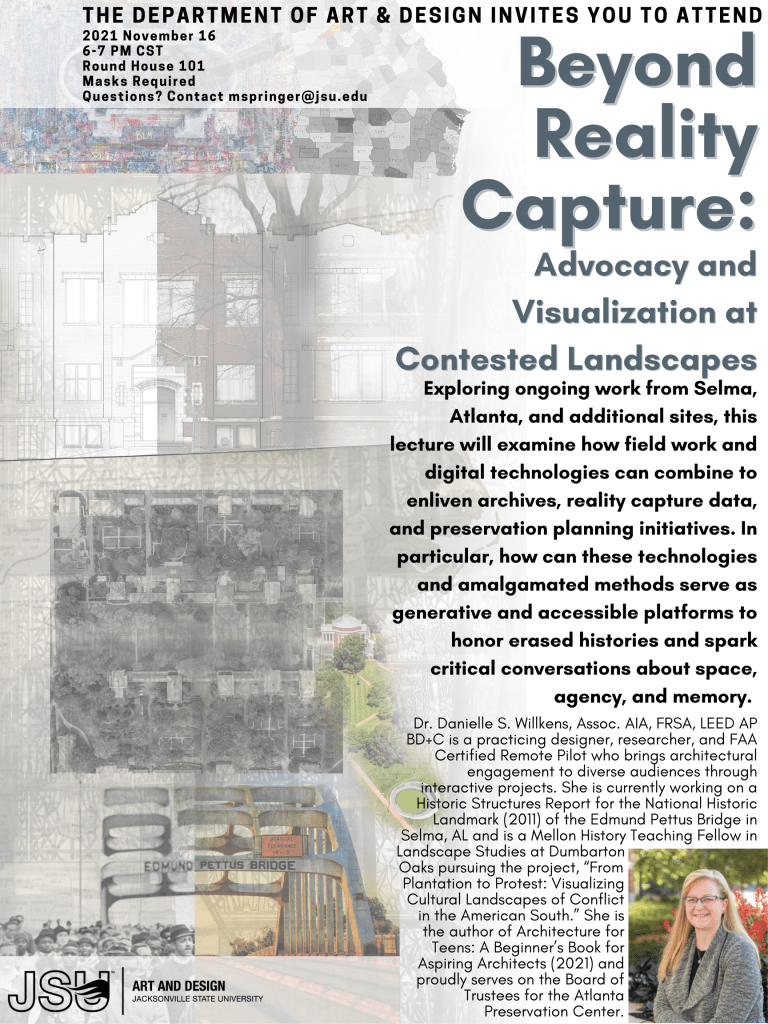
With her knowledge and passion for art history, Springer has arranged a virtual public guest lecture by Dr. Danielle Willkens of Georgia Institute of Technology. This lecture, Beyond Reality Capture: Advocacy and Visualization at Contested Landscapes, will survey how the combination of field work and digital technologies is used to “enliven archives, reality capture data, and preservation planning initiatives,” specifically how those “technologies and amalgamated methods serve as generative and accessible platforms to honor erased histories and spark critical conversations about space, agency, and memory.” Dr. Willkens uses the aforementioned technologies to “recover and memorialize historical landscapes,” such as the “Bloody Sunday” march across the Edmund Pettus Bridge in Selma (March 7, 1965).
The Selma-to-Montgomery March became a National Historic Trail in 1996, and its memory as a historical landscape is known mostly through photographs, news media, and scholarship. Willkens digitally recreates the spatial and temporal landscape from that day, as she said, which will “allow you to step back in time and see what it was like,” Springer said.
The lecture will be held on Tuesday, November 16, at the Roundhouse (Anders Hall) at 6pm. Students in art history, design, photography, and film are encouraged to attend the lecture and observe how Willkens uses the technologies they are learning about to document and visualize spaces in the American landscape.
 JSU Arts, Humanities & Sciences Blog
Leave a comment