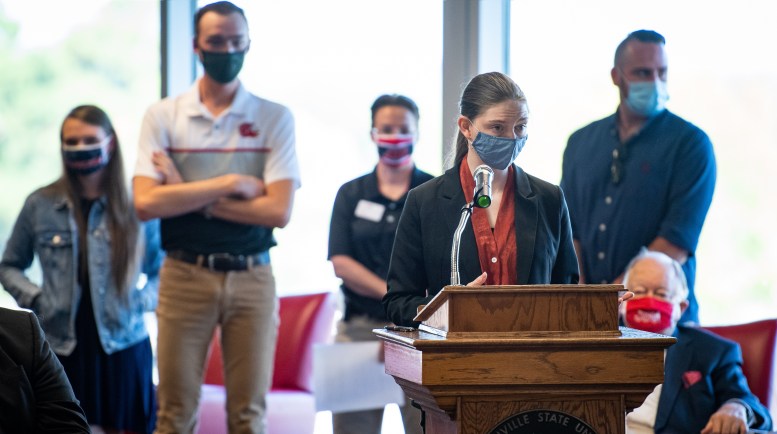
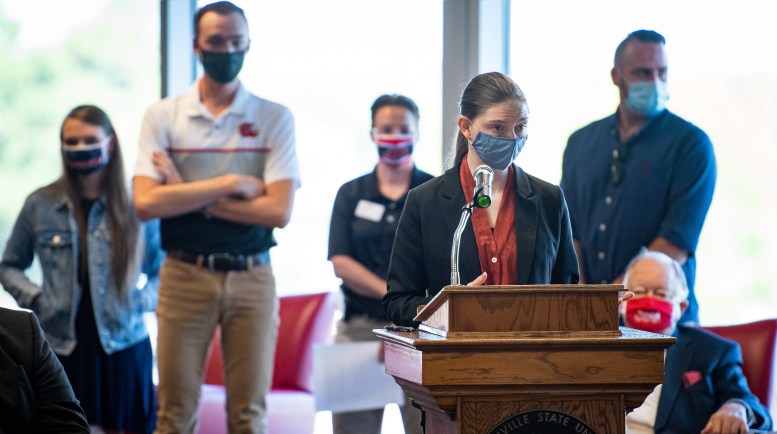
The group of faculty and students who participated in JSU’s BioDesign course in Spring 2020 presented their work to the JSU Board of Trustees on October 19. Professor Allison McElroy (Art & Design) introduced the project and course before showing a clip from the finalist team’s project video.
As Professor McElroy pointed out, finding solutions to issues such as reversing the damage mankind has done to the planet is going to take creativity and collaboration. That’s why JSU art students joined with their peers in applied engineering and biology to participate in the 2020 Biodesign Challenge. Sponsored by the National Endowment for the Arts, the prestigious BioDesign Challenge invited JSU as one of only 46 high schools and universities from across the globe and the only university in the Southeastern United States chosen to participate in the international competition. JSU joined prestigious schools such as UC Berkley, Carnegie Mellon, and Parsons School of Design, among others.
“It’s putting our name out there internationally,” said McElroy, professor of painting and drawing. “This is the future, and by giving our students this opportunity, JSU is leading the way.”
After the video, Dr. Jimmy Triplett, associate professor of biology, talked about how the course provided an opportunity for professional development for him, as he worked with colleagues from diverse disciplines to deliver the course. He pointed out that the course itself was a professional-type of course for students, who gained experience with critical and creative thinking in a project-based, hands-on environment where they had to work as a team.
Then, Teje Sult, instructor of applied engineering, introduced four students who had participated in the BioDesign course. Abigail Read, a recent graduate in art, spoke on behalf of the students. She pointed out that she had never had a course like the BioDesign one and that it allowed her to see the spaces used by biology and applied engineering while learning how students in those disciplines view problems from a different perspective. She said it was such a valuable learning experience.
“We had artists creating, scientists editing genes, and engineers making it all come together,” McElroy said.
The student-led teams created three concepts for the competition:
- The Atlas Project: Aimed at clearing the skies of smog and pollution, this project used balloons to filter the air and collect space debris. Group members included Matthew Hillgartner and McKenna Mitchell.
- The Ocean’s Plastic Eating Robot (TOPER): This animal-like robot would work to remove the 10 billion pounds of trash from the Earth’s oceans. Group members included Gabrielle Armstrong, Kate Dempsey, Jamal James, Emma Lindsey, Ruby Thamert and Reagan Tidmore.
- Vital Skin: To combat the rising cost of health care, this skin implant would provide at-home diagnostics, diagnoses and treatments to patients with limited access to health care providers. Team members included Avery Lowe, Abigail Read, Kyra Watral, Will Milner, Thomas Galbreath and Amanda Pinckard.
These projects can be seen on the BioDesign Challenge website.
After the class projects were completed by the students and edited and packaged by MFA graduate assistant Carol Record, they were sent to expert consultant Will Walker, an interactive designer at Google in San Francisco, for assessment. Walker selected Vital Skin as the winning concept, which competed in the global competition on June 15-19.
Originally, the winning team was scheduled to travel to New York City to present their final designs at the Metropolitan Museum of Modern Art (MOMA) but, due to COVID-19, the competition took place entirely online this summer. The JSU team presented their solution on June 16. Participating in this competition provided JSU students with unique networking opportunities and an impressive credential for their resumes.
“This process gives the artist a new voice,” McElroy said. “We’re not just making pretty pictures, but discussing how we can help make things better in the future.”
Students interested in BioDesign might begin with ART 130: Creative Thinking; the BioDesign course should be available again Spring 2022.
 JSU Arts, Humanities & Sciences Blog
Leave a comment