
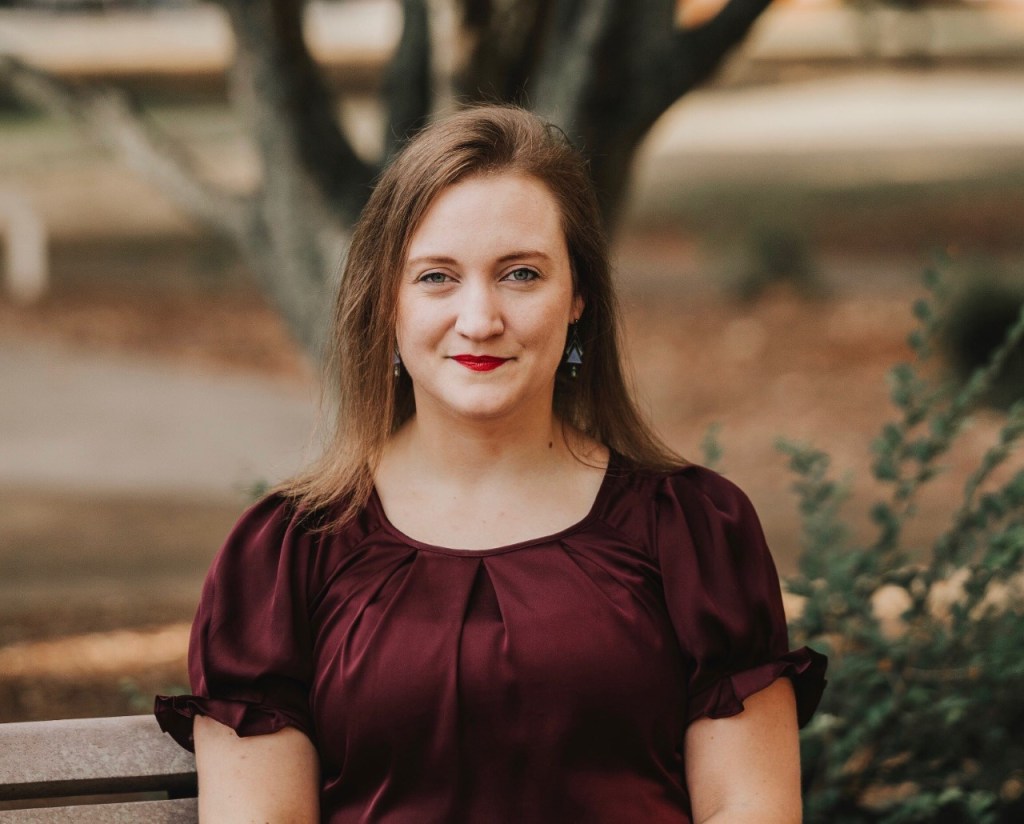
Featured Faculty: Mary R. Springer
Dr. Mary Springer, assistant professor of art in the Department of Art & Design, has been teaching at JSU for three years. Originally from Nebraska, Springer has become actively engaged in the Jacksonville community through the Jacksonville Arts Council and an art program for children.
Springer’s area of specialization is art history, especially American collegiate architecture and campus planning. She teaches undergraduate and graduate art history courses, such as American art, modern art and architecture, and graphic design history. She frequently presents her research at conferences, and she is working on a book and a few articles. Tentatively titled “The Gothic Goes to College: An Architectural History of American Collegiate Gothic, 1806-1945,” her book project is an adaptation of her doctoral dissertation.
“For many Americans, learning in grand Collegiate Gothic buildings on a picturesque campus represents the archetypal college experience,” stated Springer. “Scholars have not regarded the style in its own right, having its own history within the nineteenth- and twentieth-centuries’ dynamic developments in higher education, religion, politics, urban planning, and architecture. My scholarship evaluates these relationships in a cohesive narrative of American Collegiate Gothic architecture from its nineteenth-century beginnings to its increasing popularity during the interwar decades.”
Related to her book project, Springer is finalizing an article adapted from a recent conference paper about the University of Pittsburgh’s Cathedral of Learning, an academic skyscraper designed by Philadelphia architect Charles Z. Klauder. Another article Springer is finishing elucidates African American architect Julian Abele’s contributions to Duke University’s Collegiate Gothic West Campus. Springer brings her research into the classroom, and she escorts students on fieldtrips to experience nearby architecture for themselves.
Springer’s favorite courses are Modern Architecture (ART 451) and American Art and the Old South (ART 389). “Both courses focus on visual artifacts that define our daily experiences – each and every day we occupy American buildings, we encounter American art, and we wander through American landscapes,” said Springer. “Our experiences are defined, in large part, by our visual surroundings. My goal as an art history professor is to demonstrate to students how art and architecture represent socio-political values of cultures worldwide. I encourage my students to engage individually and socially with their visual surroundings.”
One of Springer’s favorite assignments is a writing activity in the first week of lower-level art history, when the students tour the JSU campus and write about their visual experience: What do they see, what did they like about the campus, what did they dislike, and if they were campus planners, what would they do differently. “Not only does this relate to my own research on collegiate architecture, but it helps to engage students’ visual and critical thinking skills. It’s a lesson in looking,” stated Springer. In addition to on-campus fieldtrips, Springer takes students to nearby architectural sites.
For example, Springer and her students have travelled recently to two important sites in Alabama. In Springer’s Modern Architecture and American Art, students learn about Frank Lloyd Wright and explore his undeniable influence on American and European modernism. “Two years ago, I took students to Wright’s Usonian house in Florence, Alabama, and it was an absolute joy hearing students recall and discuss the architect’s stylistic principles” stated Springer. More recently, Springer and her students travelled to visit Paul Rudolph’s well-known chapel at Tuskegee University. “Rudolph, an Auburn University alumnus, is an important Brutalist architect, and I couldn’t believe that one of his masterpieces happens to be just down the road!” exclaimed Springer. “My students commented on the space’s dynamic interplay of light, mass, and void. The play of light on the ever-changing wall surfaces activates the space…and the building’s mass appears to move before your eyes!”
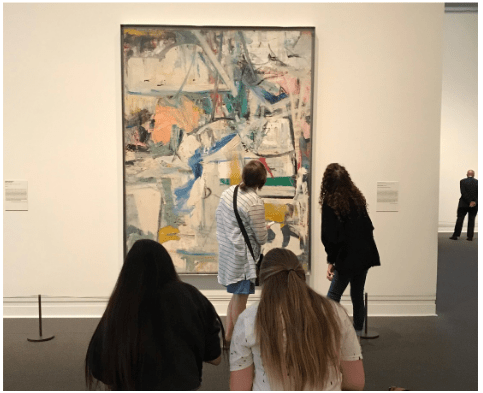
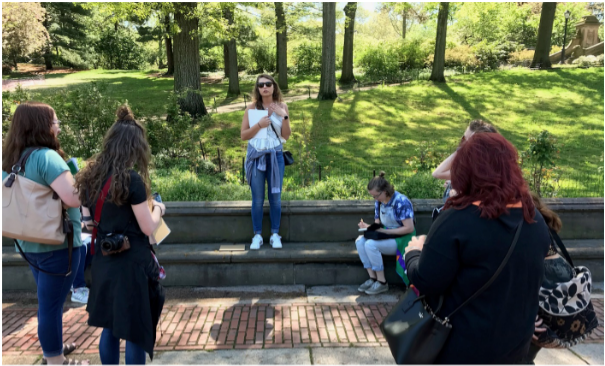
Springer has also taken JSU students to New York City. With Drama Department Head Randy Blades, Springer co-taught a New York Study Tour, for which art and drama students learned both theatre and art history throughout the semester, with the course culminating in a trip to New York City. “One of the most rewarding experiences as a teacher is seeing the students excited about what they learn,” stated Springer. “In New York City, for example, it was an absolute joy to see art history students present their research about art and architecture on site, in front of the artwork or sculpture, within the park, in the lobby of buildings…whatever topic they opted to research and write about.”
In addition to teaching, Springer engages with the Jacksonville community through service work. As a member of the Jacksonville Arts Council, Springer’s main role is arts outreach (children’s art lessons and community art engagement). “Because art played such a major role in my childhood, I enjoy volunteering for children’s art activities,” said Springer. Once a month at the Jacksonville Community Center, Springer manages an after-school arts program for children (ages 6-12). In recent months, the kids created mobiles resembling those of Alexander Calder, collaborated on Surrealist-inspired Turkey exquisite corpses, and rendered Cubist portraits inspired by Pablo Picasso.
Springer has the following advice for JSU students: “Ask your instructors for help. If you struggle with note taking, research, writing, exams, and reading comprehension, we are here to help you! Nothing makes me happier than seeing students improve and succeed. Also, enroll in courses outside of your chosen discipline. You have your entire career to focus on your discipline, but how many opportunities will you have to learn music, history, literature, geology, political science, theatre, sociology, biology, math, and more from experts in their fields? This is your time to learn and enjoy new experiences. Also, sketch all of the time. I used to carry around a small sketchbook and ballpoint pen. I sketched buildings, artworks in museums, landscape surroundings, and more. Sketching with a pen helped me improve my hatching technique and line quality. Sketching also reinforces our desire to look and study our visual surroundings. When I’m researching a new building, sketching the façade and plan helps me to discern details I missed in initial formal studies.
JSU art students Anna Milner and Kayli Jones with children’s ‘exquisite corpse’ turkeys, November 2019

Students at Frank Lloyd Wright’s Rosenbaum House, Florence, AL (November 2018)

Students at Paul Rudolph’s Tuskegee University Chapel, Tuskegee, AL (November 2019)
Photographs taken by Mary Springer

New York Study Tour, May 2019
Olivia Sims giving an onsite presentation about Willem de Kooning’s Easter Monday in the Metropolitan Museum of Art
Mary Grace Porter giving an onsite presentation about Central Park’s history and design
 JSU Arts, Humanities & Sciences Blog
Leave a comment