
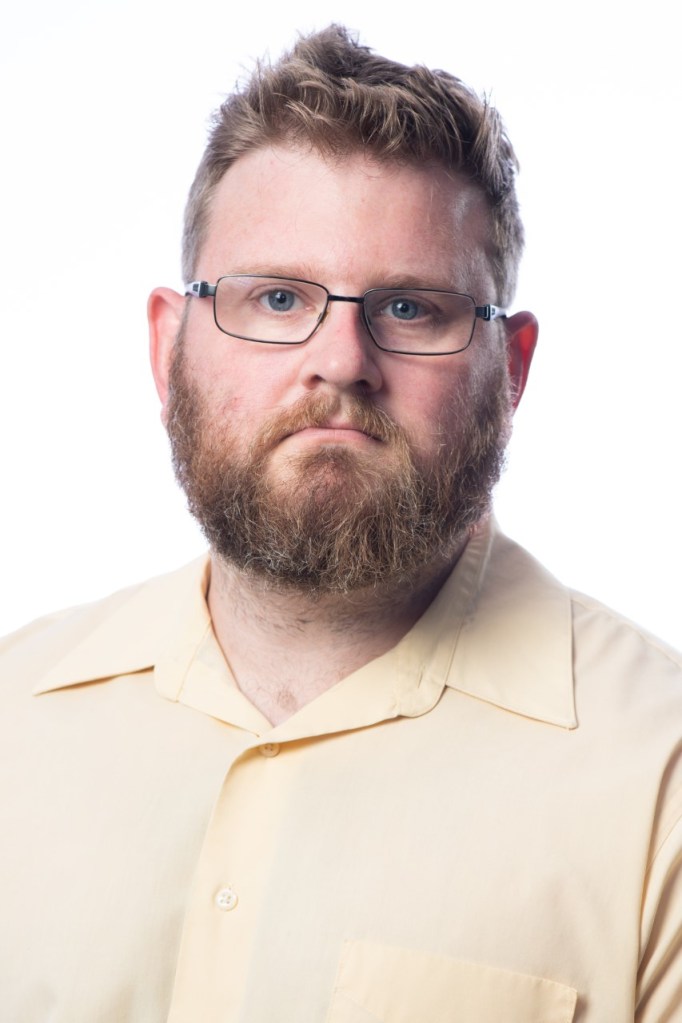
Dr. Christopher Douglas recently joined the School of Arts and Humanities as an Assistant Professor of English. Before he joined the JSU English Department, Dr. Douglas was teaching at the University of Alabama as an Instructor of English. He is excited to teach upper-level courses in his area of expertise at JSU.
Where are you from?
I am from a small farming community in Illinois. It’s smaller than Jacksonville. I grew up living across from the only hospital in the county; behind that was a corn field. Supposedly the town was named by pulling letters out of a hat until they got something that sounded nice. I miss winter deeply.
Do you have any pets?
I have a rescue dog named Honey who is far more photogenic than me. She’s a shih-tzu terrier mix. She’s from a rescue near Tuscaloosa and is an Alabama native. I take her for walks on JSU’s campus a couple times a week, so if you see me walking her, you’re more than welcome to flag me down. I may look dour, but she’s very friendly, I promise.
What classes are you teaching this semester?
I am currently teaching two sections of EH 101, that’s freshman composition, one section of EH 203, that’s the first half of the British Literature seminar, which goes from the medieval period through the 1780s, and one section of EH 322, which is a business-writing course. Next semester I’ll be teaching a 500-level course on 18th-century novels, taught online.
So far, what has been your favorite thing about working at JSU?
Well, as I’ve only been here for about two months, I’m still working my way through the JSU system. What I’ll say is perhaps what JSU sells itself as–the Friendliest Campus in the South–is actually an accurate description. Everyone with whom I’ve worked in my department and my interactions with administration have been very welcoming.
Why/how did you decide to pursue English?
I both did and did not see myself majoring in English. I was that child who always had a book in his hand, reading at sporting events, family functions, and any spare moment. When I got to high school, however, I had some teachers suggest that I become an engineer, so I took their advice. I went to school to become an engineering student. And when you become an engineering student, one thing that they tell you, at least in my program, was that there’s a high burnout rate. I was an electrical engineering student for five semesters, desperate to find anything that I enjoyed about the program. I could do it–although I certainly wasn’t the top of my class by any means–but there was nothing about it that I actually liked doing. So, after the fall midterms of my junior year I sat down and asked myself what would make me happy, and the only thing that came to my mind was all of those books that I had loved, and still loved. So, off I went, to change majors from Electrical Engineering to English.
What is your specialization in?
My degree is in 18th-century British literature. This became my eventual area of study thanks to a course I took in undergrad on the 18th-century transatlantic novel. The novels were all terrible; I loved them deeply for their flaws. To this day, I say that my favorite novel is The Power of Sympathy (1789) by William Hill Brown because, in my opinion, every time it could make a good choice it doesn’t, and yet it’s so very earnest in all of its bad decisions that I can’t help but admire it. My focus is on it-narratives, which are stories narrated by non-humans–objects and animals whose autobiographies serve to string together otherwise disconnected stories of the people with whom they come into contact. I sometimes put it this way: when there’s a pincushion, kitten, thimble or horse who wants to tell you their life story, I’m there.
Did you always plan on teaching?
Some people come from families of teachers; I am not one of them. Nobody in my immediate or extended family works in education. As a child, I wanted to be a veterinarian until I realized that I was not going to be able to handle the blood. I did a job shadowing project in city hall in Jr. High and I found it immensely boring. For several years, I felt that I was going to be an electrical engineer, and teaching never crossed my mind. When I finally changed majors to English, it was with a secondary education focus because I wanted to share the experiences that I enjoyed so much with others.
Are you currently working on any creative works? Any research?
I have an article forthcoming in JNT about reading Natsume Soseki’s first novel I am a Cat (1904-05) as an it-narrative. It’s actually this novel, which I read when I lived in Japan, that spurred me into studying it-narratives as a whole. I’m also tinkering on an article about the search for an authoritative–yet still human–narrative style in Daniel Defoe’s Continuation of Letters Written by a Turkish Spy (1718) and Sarah Fielding’s The Life and Adventures of David Simple (1744).
What was the last book you read, and why?
Well, this is a dangerous question to ask an English professor. I’ll give two answers, what I’m reading professionally and what I’m reading for fun. Professionally, I’m reading Charlotte Lennox’s The Female Quixote (1752), a novel about a woman who reads too many French romances from the 17th century and the trouble that this causes when it turns out that 1750s England does not actually function on the bombastic, overly-elaborate rules of historical romances. So, it’s a book about book reading, which is exactly the sort of novel an English professor would be interested in. I also just finished reading Ursula K. Le Guin’s The Farthest Shore (1972), which is a fantasy novel written by one of my favorite authors of 20th-century sci-fi. I find it nice to read things that I don’t have to think about for publication, but that I read just for myself. Le Guin is one of my just-for-me authors.
What accomplishment(s) are you most proud of?
Well, my New Year’s resolution for this year was to deadlift 500 pounds, and I did. I once made a rosemary grape sorbet topped with a moscato zabaglione and fresh strawberries that still haunts my taste buds. I lived for three years in Japan, not really knowing any Japanese when I first arrived and knowing enough to get by in everyday life by the time I left (although sadly my Japanese has atrophied after a decade of disuse). I was one of the first people in my family to get a college degree.
Do you have any advice for JSU English students?
I wrote my dissertation two pages at a time, five days a week. After a few months of this, I had 275 pages that I had to edit down. From there, I edited 20 pages a day. I ended up with a 240 page document. Had I sat down in September and said “time to write 240 pages” I would have felt overwhelmed and lost before even writing the first line. Small, manageable goals turn into larger projects if followed through. Give yourself the time and space to work on things in small portions, and you won’t feel overwhelmed.

 JSU Arts, Humanities & Sciences Blog
Leave a comment