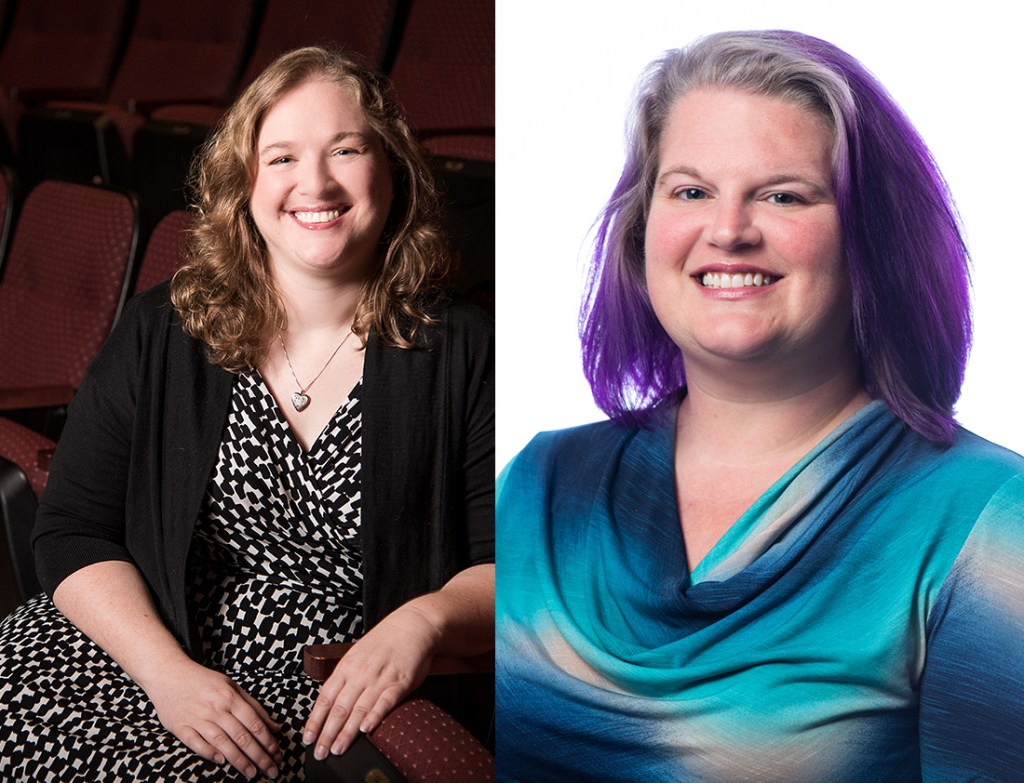
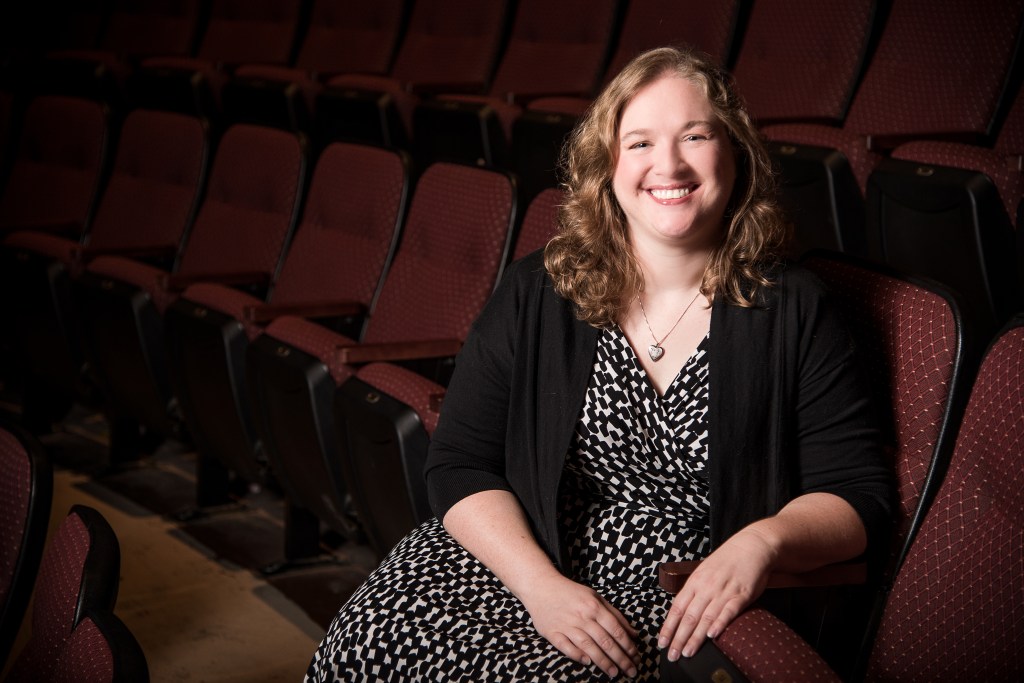

This March, both Jennifer Luck and Dr. Ellen Peck, drama faculty, attended and co-taught a seminar (“Fire the Canon! Diversifying Academic Theatre Repertoire”) at the SETC Conference in Knoxville, TN.
Peck is an Associate Professor of Drama, and she teaches Theatre History, Musical Theatre, Theory, and Stage Management. This semester, she is teaching a Contemporary Drama course. Luck is an Assistant Professor of Scenic and Lighting Design, so she teaches the Drama Department’s design and lighting courses.
The idea for the workshop came from a children’s production of Peter Pan Jr. Luck explained that the children’s costumes “brought up questions about the portrayal of Native Americans in drama, and things that by our present day standards wouldn’t be considered politically correct.” For example, the children playing Native Americans were white, portrayed a caricature of the culture, and wore feathers—traditionally viewed as sacred in Native American culture. Although the characters were written into the play, it ended up being outdated and offensive on the stage.
This experience started the Luck and Peck’s discussion about the contemporary performance of plays that may not be culturally sound anymore. “How do we perform those plays in a contemporary way that isn’t offensive?” Luck asked. One option is to reimagine these older scripts and leave out problematic elements—yet the act of re-writing and changing plays is difficult. Luck explains that it’s illegal to change licensed works when you pay royalties to the playwright; however, the plays can be “reimagined” to be appropriate for contemporary society, which isn’t the same as censorship. Ultimately, however, she says that “if you have concerns about content within a show, the simplest way to avoid problems is to just not do that show.”
The conversation quickly moved to a greater issue: the lack of diversity in Drama. What had started as a question of how to accurately portray minority characters quickly turned into a discussion of how to include—and celebrate—those minorities in Drama.
Diversity is a recurring issue in older works due to the overwhelming prevalence of straight white males writing straight white male characters. “Roman theater, Greek theater, Shakespeare—they’re all very white male dominated,” Luck said. Because of this, Luck believes that it is important in today’s society to adapt the canon, diversify our syllabi, and introduce new perspectives into the drama world—both in casting and playwriting. And this isn’t to say that the traditionally studied and performed plays aren’t worth studying—Luck just “doesn’t know how much value we get as artists and audiences seeing them produced over and over again.” Luck said that we should ask ourselves if we should continue producing these canonical productions that lack diversity. “Maybe we need to start thinking about the voices that have been excluded from theater for a long time,” she said. Her goal isn’t necessarily to diversify drama—the drama world is already diverse!—but to purposefully incorporate diverse works and playwrights. “It’s not that we haven’t had African American, women, or LGTBQ+ playwrights, but their works tend to be less produced than traditional plays,” Luck said.
It was this conversation about the importance of diversity in contemporary drama that prompted Luck and Peck to create and present their seminar at the SETC Conference. The week-long conference had over five thousand members in attendance, and hosted several workshops on all things theater. Peck and Luck co-taught a workshop about diversifying academic theatre repertoire with faculty from the University of Tennessee—Chattanooga, Miles College, and Clay Chalkville High School. They discussed how academic theatre could support diversity and inclusion through production choices and classroom studies, and focused especially on minority playwrights.
After the conference, Peck and Luck wanted to keep the conversation alive, so they created a Facebook group. The Facebook group, which is still active, currently has 221 members composed of students, professors, professionals, and playwrights—“all interested in diversifying the stories we are telling.” They also created a website to provide resources for producing and studying diverse works. Professors are able to share their syllabi, collaborate with other professionals, and discuss contemporary works.
In response to this work, Peck decided to teach a Special Topics course on Contemporary Drama for the fall 2019 semester. The syllabus includes female, Native American, Hispanic, African American, Asian, Muslim, and lesbian playwrights. All of the playwrights are American and provide a variety of perspectives and backgrounds.
“Some of these plays I’m reading for the first time, myself,” Peck said. She is excited to explore these new perspectives and genres alongside her students, who are becoming more aware of the rich diversity in contemporary drama. Her students specifically mentioned how interested they are to study these new plays with unfamiliar subjects and backgrounds.
To Luck, introducing new, contemporary works from diverse playwrights in the classroom is a crucial step in diversifying drama. It’s important to include these new productions in our classrooms and on the stage because, as Luck said, “we default to what we know.” If we don’t widen what we teach and perform, we perpetuate the cycle of one-dimensional drama studies and don’t benefit from the broad perspectives in contemporary drama.
As Luck summed up, the end goal of all these seminars, projects, and classes is simply to “amplify the voices of those who haven’t historically been represented in theater.”
 JSU Arts, Humanities & Sciences Blog
Leave a comment